
Charter Street Cemetery in Salem, Massachusetts
Explore Nearly 400 Years of Salem History
Established before 1637, Charter Street Cemetery is Salem’s oldest European burial ground and one of the oldest surviving colonial cemeteries in the United States. Also known historically as the Old Burying Point, the cemetery offers a remarkable look into nearly four centuries of Salem history.
The burial ground contains the graves of early settlers, merchants, judges, craftspeople, religious leaders, veterans, enslaved people, and members of some of Salem’s most prominent families. Its surviving gravestones also preserve an exceptional collection of 17th-, 18th-, and 19th-century New England funerary art.
While Charter Street Cemetery is Salem’s oldest European burial ground, Indigenous peoples lived in and cared for this region for thousands of years before English colonization. Indigenous burial places and sacred landscapes in Salem predate the establishment of the cemetery.
The Oldest Colonial Burial Ground in Salem
The exact date Charter Street Cemetery was established is unknown, but historical records confirm that the land was already being used as a burial place by 1637.
That year, Salem town records granted a local man named John Horne permission to erect a windmill in what the record described as the “burial place.” A second reference appeared in 1639, when the town ordered Horne to remove an enclosure he had created within the burial ground.
The surviving 1639 town record states:
“ordered yt John Horne shall desist from his inclosure in ye bury all place: and yt ye town shall pay for a quarter of an acre when he hath bought ye same. except the Towne when they shall haue changed the buryall place shall alow him a portion of the same.”
These records show that the property was already recognized as a community burial ground during Salem’s earliest colonial period.
The cemetery remained in use into the late 19th century. Although many people were buried here without permanent markers, and numerous early stones have been lost, damaged, replaced, or made illegible over time, hundreds of surviving monuments continue to document Salem’s changing population and history.
Historic Gravestones and Funerary Art
Charter Street Cemetery occupies approximately 1.47 acres and contains one of New England’s most significant collections of colonial gravestones and funerary art.
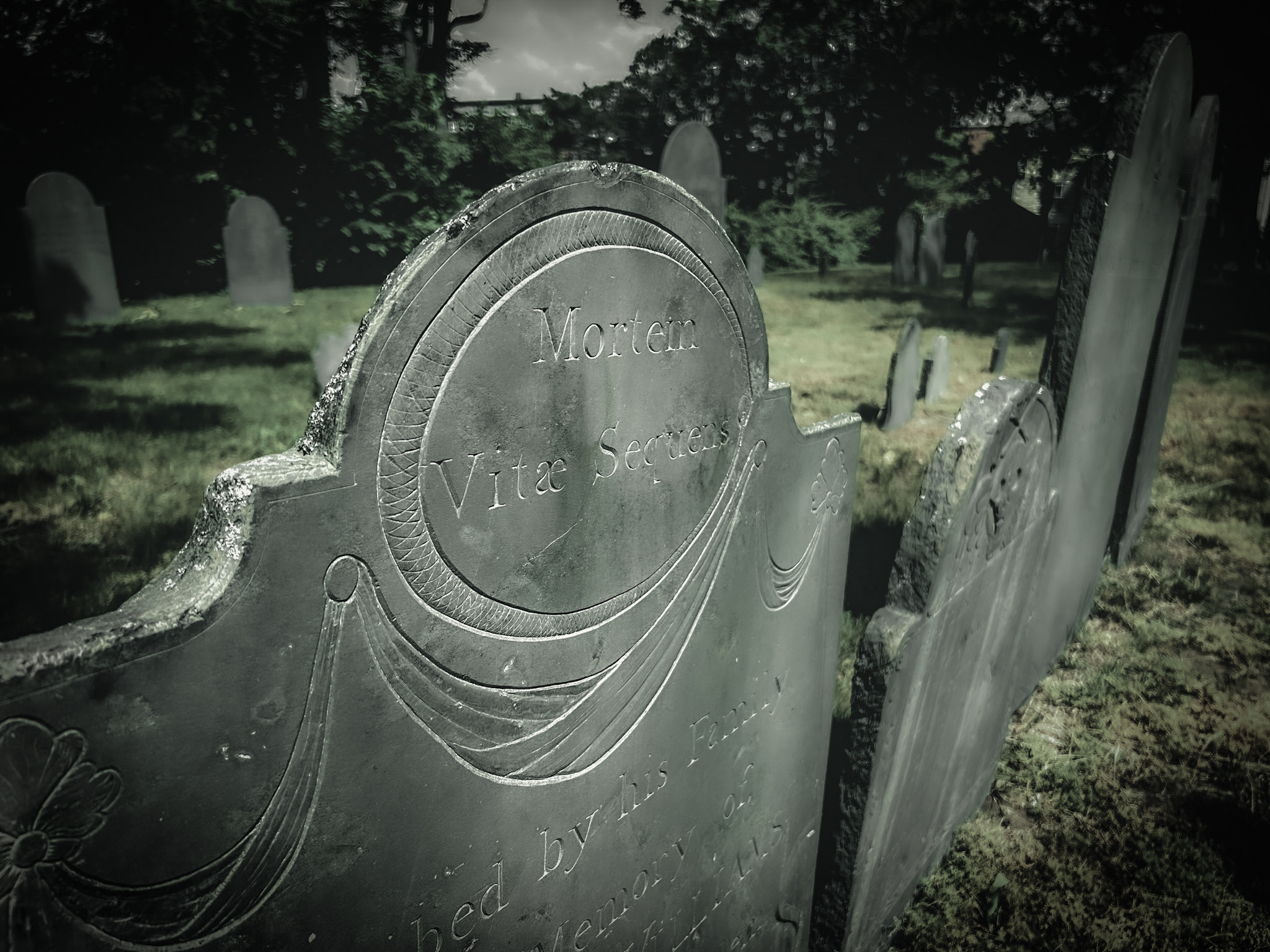
Most of the surviving grave markers are carved from slate, although marble, sandstone, and other materials can also be found throughout the burial ground. Visitors may see traditional headstones and footstones, along with larger chest or box tombs that provided access to family burial chambers below ground.
The stones feature imagery commonly associated with New England burial traditions, including winged skulls, hourglasses, skeletons, cherubs, urns, willow trees, and other symbols of death, remembrance, resurrection, and mourning.
Changes in the carvings, lettering, language, and materials reveal how attitudes toward death and the afterlife evolved between the 17th and 19th centuries.
The Oldest Surviving Grave Markers
The earliest surviving death date represented in Charter Street Cemetery belongs to Doraty Cromwell, who died in 1673. Cromwell was a midwife, an important occupation in early colonial communities where women provided essential care during childbirth.
Her original stone suffered extensive damage, and its inscription was recut during the early 20th century. Other particularly early markers include those associated with Caleb More, who died in 1674, and Sarah Higginson, who died in 1675.
It is important to remember that the oldest surviving stone does not necessarily represent the cemetery’s first burial. The burial ground had already been in use for decades before these deaths, but many earlier markers may have been made from wood, fieldstone, or other materials that did not survive.
Charter Street Cemetery and the Salem Witch Trials
Charter Street Cemetery was an active burial ground during the Salem Witch Trials of 1692. However, the cemetery was not an execution site and did not serve an official function during the trials.
No confirmed victim of the 1692 witchcraft executions is buried in Charter Street Cemetery. Those executed by the colonial government would not have been formally interred in the municipal burial ground. The final resting places of most of the victims remain uncertain.
The cemetery is nevertheless directly connected to the history of the Salem Witch Trials because several judges and officials involved in the proceedings are buried here. They include John Hathorne and Bartholomew Gedney, both of whom served on the Court of Oyer and Terminer.
The court was established in 1692 to “hear and determine” the growing number of witchcraft cases. Its proceedings resulted in numerous convictions and executions before it was dissolved later that year.
The presence of these judges’ graves provides an opportunity to reflect on the legal failures, social pressures, religious fears, and lasting consequences of the Salem Witch Trials.
Notable People Buried at Charter Street Cemetery
Richard More
Richard More traveled to Plymouth Colony as a child aboard the Mayflower in 1620. He later became a mariner and lived for many years in Salem.
His grave is one of the cemetery’s most frequently visited monuments and provides a direct connection between Salem and the story of the Mayflower migration.
Doraty Cromwell
Doraty Cromwell was a midwife whose 1673 death date is the earliest represented by a surviving marker in Charter Street Cemetery.
Her inclusion among the cemetery’s notable burials also highlights the vital but frequently underdocumented work performed by women in early colonial communities.
Judge John Hathorne
John Hathorne was a Salem merchant, magistrate, and one of the judges involved in the Salem Witch Trials.
He participated in the early examinations of accused individuals and later served on the Court of Oyer and Terminer. Hathorne was also an ancestor of author Nathaniel Hawthorne, who added the letter “w” to the family surname.
Unlike fellow trial judge Samuel Sewall, John Hathorne left no known public apology for his participation in the proceedings.
Bartholomew Gedney
Bartholomew Gedney was a Salem merchant, physician, magistrate, and member of the Court of Oyer and Terminer during the Salem Witch Trials.
Gedney was one of several prominent Salem men appointed to hear the witchcraft cases in 1692. His burial at Charter Street Cemetery represents another direct connection between the site and one of the most consequential chapters in Salem’s history.
Chief Justice Benjamin Lynde Jr.
Benjamin Lynde Jr. was a Salem-born judge who served as chief justice of the Massachusetts Superior Court of Judicature.
In 1770, Lynde and three other judges presided over the trials arising from the Boston Massacre. The proceedings included the trial of the British soldiers accused in the deaths of Crispus Attucks, Samuel Gray, James Caldwell, Samuel Maverick, and Patrick Carr.
Lynde’s surviving handwritten notes provide historians with an important record of the testimony and legal arguments presented during the trials.
Primus Lynde
Primus Lynde was an African man enslaved by the Lynde family.
His burial at Charter Street Cemetery is an important reminder that the history represented here extends beyond Salem’s wealthy merchants and political leaders. The cemetery also contains evidence of people whose lives were shaped by slavery, servitude, inequality, and systems that often excluded them from the written historical record.
Elias Hasket Derby
Elias Hasket Derby was one of Salem’s most successful merchants during the years following the American Revolution.
His ships participated in an expanding international trade network that connected Salem with ports throughout Europe, the Caribbean, the Indian Ocean, and Asia. Derby accumulated extraordinary wealth and is frequently described as one of America’s first millionaires.
His burial reflects Salem’s transformation from a colonial settlement into one of the young United States’ most important maritime trading centers.
Samuel McIntire
Samuel McIntire was a Salem woodcarver, furniture maker, architect, and designer whose work helped define the architectural character of the city.
McIntire designed or contributed to numerous homes and public buildings, particularly during Salem’s Federal-period prosperity. His detailed woodcarving and architectural ornament became internationally recognized examples of early American craftsmanship.
Salem’s McIntire Historic District is named in his honor.
Nathaniel Mather
Nathaniel Mather was the son of influential Puritan minister Increase Mather and the brother of Cotton Mather.
He died in Salem in 1688 at the age of 19. His grave connects Charter Street Cemetery to one of colonial New England’s most prominent religious families.
Simon Bradstreet
Simon Bradstreet was a colonial magistrate, businessman, and governor of the Massachusetts Bay Colony.
He was married to Anne Bradstreet, one of the earliest published poets in English North America. Simon Bradstreet served multiple terms as governor and remained active in colonial government for decades.
His burial reflects the cemetery’s close association with the political and religious leadership of early Massachusetts.
Salem’s Merchant Families
Charter Street Cemetery also contains the graves and family tombs of many people connected to Salem’s maritime prosperity.
Members of the Derby, Forrester, Fiske, Crowninshield, Pickman, and other merchant families helped establish trade networks that carried Salem vessels around the world. Their monuments tell stories of wealth and influence, but also of dangerous voyages, disease, shipwreck, war, enslavement, and the human costs of international commerce.
A Cemetery for the Salem Community
Charter Street Cemetery was a public burial ground rather than a cemetery reserved exclusively for one congregation, social class, or religious group.
People did not necessarily have to be residents of Salem to be buried here. However, the surviving stones do not represent every person equally. Wealthier families were more likely to purchase durable, professionally carved monuments, while people with fewer resources may have had simple stones, wooden markers, or no permanent marker at all.
As a result, the visible cemetery provides only a partial record of the people buried beneath it.
Women, children, laborers, servants, sailors, enslaved people, Indigenous people, and poorer residents are often less visible in the surviving landscape. Understanding those absences is an important part of interpreting the cemetery honestly.
National Register of Historic Places
The historical and architectural significance of Charter Street Cemetery was formally recognized in 1975, when the Charter Street Historic District was added to the National Register of Historic Places.
The small historic district includes Charter Street Cemetery, the Pickman House, and the Grimshawe House. Together, these properties preserve part of Salem’s early physical landscape within the modern downtown area.
The cemetery remains one of the district’s most visible and historically significant features.
Preservation of Charter Street Cemetery
Centuries of exposure, erosion, tree growth, freeze-and-thaw cycles, vandalism, pollution, and heavy foot traffic have placed many of the cemetery’s grave markers and tombs at risk.
The City of Salem began a multiphase conservation project in 2016. Initial work included the professional restoration of 23 headstones and eight box tombs, along with a landscape assessment and recommendations for protecting the burial ground.
A second phase focused on landscape restoration and was completed in 2021. Improvements were designed to protect fragile monuments, manage visitor movement, reduce soil compaction, and preserve the cemetery as both a historic resource and a place of burial.
Visitors can assist with preservation by remaining on designated paths and avoiding physical contact with grave markers and tombs.
Visit Charter Street Cemetery Respectfully
Charter Street Cemetery is an important Salem historical attraction, but it is also a real public cemetery and should be treated as a place of remembrance.
Visitors are welcome to walk along the established paths, view the historic grave markers, and take photographs. Guests should not climb, lean, sit, or stand on gravestones, walls, or box tombs.
Grave rubbings are not permitted because pressure and repeated contact can damage fragile stone surfaces. Replica stones available inside the Charter Street Cemetery Welcome Center provide an opportunity to study historic carvings more closely without harming the original monuments.
Visitors should also avoid leaving coins, stones, candles, plastic flowers, or other objects in the cemetery. Even well-intentioned offerings can stain stones, interfere with maintenance, or contribute to deterioration.
Charter Street Cemetery Welcome Center
The Charter Street Cemetery Welcome Center is located in the historic Pickman House near the cemetery entrance.
Exhibits inside the welcome center explore the cemetery, the Pickman House, funerary traditions, gravestone symbolism, local history, and the Charter Street Historic District. Visitors can learn more about the people buried in the cemetery and gain a better understanding of how the site has changed over nearly four centuries.
The welcome center also includes a gift shop. Proceeds help support the preservation and interpretation of Charter Street Cemetery.
Discover a Broader Story of Salem
Charter Street Cemetery is sometimes approached primarily through its connection to the Salem Witch Trials. That connection is important, but the history preserved here is much broader.
The cemetery tells stories of colonial settlement, Indigenous displacement, religious belief, public health, childbirth, childhood mortality, slavery, maritime commerce, architecture, craftsmanship, war, family life, social inequality, and changing attitudes toward death.
Every surviving marker represents only part of a life. Together, the graves and monuments create one of Salem’s most valuable historical landscapes and offer visitors a deeper understanding of the people who shaped the city.
By visiting carefully and respectfully, guests help protect Charter Street Cemetery so that its stories can continue to be studied, shared, and remembered.